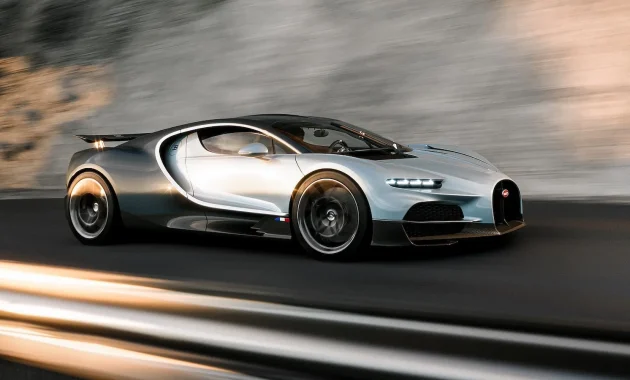

The Bugatti Tourbillon is not just a car; it is a historical pivot for the most prestigious brand in the automotive world. For twenty years, Bugatti was defined by the W16 engine and its four turbochargers—the heart of the Veyron and the Chiron. However, for 2026, Bugatti has done the unthinkable. They have retired the turbochargers in favor of a massive, naturally aspirated V16 engine paired with three electric motors. The name “Tourbillon”—a French term for a complex mechanism in high-end watchmaking that counters the effects of gravity—perfectly describes the car’s philosophy. It is a vehicle designed for “eternity,” moving away from digital screens and towards mechanical, analog beauty. It is the first completely new Bugatti in eight years, and it stands as the most powerful naturally aspirated car ever produced.
The soul of the Tourbillon is its 8.3-liter V16 engine, developed in collaboration with the legendary engine builders at Cosworth. This engine is a mechanical masterpiece, measuring nearly one meter in length. Unlike the Chiron’s engine, which relied on four turbos to force air into the cylinders, the Tourbillon’s V16 breathes naturally, allowing it to rev to a screaming 9,000 RPM. This choice was made to prioritize “emotion” and “sound” over clinical efficiency. On its own, the V16 produces a monumental 1,000 horsepower and 900 Nm of torque. Because there are no turbochargers to muffle the sound, the exhaust note is described as a “mechanical thunder,” a raw, high-frequency scream that turbo engines simply cannot replicate. Despite its massive size, the engine weighs only 252 kg, thanks to the extensive use of lightweight alloys and titanium.
To bridge the gap between 1,000 horsepower and the 1,800 horsepower total, Bugatti integrated a high-voltage hybrid system. The Tourbillon features three electric motors: two on the front axle and one integrated into the 8-speed dual-clutch transmission at the rear. These motors are axial-flux units, which are incredibly compact and power-dense, spinning at up to 24,000 RPM. Together, they contribute an additional 800 horsepower. This setup provides the Tourbillon with full torque vectoring and all-wheel drive, allowing it to put its massive power onto the road with surgical precision. The electric motors also eliminate any hesitation, providing instant torque from 0 RPM, while the V16 builds its power toward that glorious 9,000 RPM crescendo.
The performance statistics are, quite frankly, difficult for the human mind to process. The Tourbillon can sprint from 0 to 100 km/h in just 2.0 seconds. But even more shocking is its long-range acceleration. It hits 200 km/h in under 5 seconds, 300 km/h in under 10 seconds, and 400 km/h (248 mph) in less than 25 seconds. To put that in perspective, the Tourbillon reaches 400 km/h faster than most performance cars reach 200 km/h. The top speed is limited to 380 km/h for standard driving, but with the use of the “Speed Key,” the car’s active aerodynamics adjust to reach a maximum of 445 km/h (277 mph). This is a car that exists on the very edge of what is physically possible for a road-legal vehicle.
Supporting this speed is a 24.8 kWh 800V battery pack housed in the central tunnel of the chassis. While the Tourbillon is a hypercar first, it is also a plug-in hybrid with an electric-only range of approximately 60 kilometers (37 miles). This allows for silent, zero-emission city driving, meaning you can roll through the streets of Monaco or London without making a sound, only to unleash 1,800 horsepower once you hit the open road. The integration of the battery into the carbon-fiber monocoque serves a structural purpose, increasing the car’s torsional rigidity while keeping the weight distribution centered.
The Bugatti Tourbillon is a defiant statement. In an era where everything is becoming digital and disposable, Bugatti has created something that feels permanent. It uses the most advanced hybrid technology in the world to support an engine format—the V16—that was thought to be extinct. It is a car that honors the past through its name and its analog soul, while simultaneously defining the future of hypercar performance. For the 250 lucky individuals who will own one, the Tourbillon is not just a vehicle; it is a mechanical heirloom designed to be just as beautiful and relevant in a hundred years as it is today.
If Phase 1 was about the violence of 1,800 horsepower, Phase 2 is about the elegance of 600 tiny parts. The Bugatti Tourbillon is perhaps the first vehicle in modern history designed with a “digital detox” philosophy. While every other manufacturer is racing to fit larger, more intrusive touchscreens into their dashboards, Bugatti has moved in the opposite direction. By collaborating with Swiss horologists, they have created an interior that is meant to be just as beautiful and functional in the year 2126 as it is today. This is the part of the car that justifies its $4 million price tag—a level of craftsmanship that transcends the automotive industry and enters the world of “Haute Horlogerie.”
The Instrument Cluster: A Swiss Watch for the Road
The centerpiece of the Tourbillon’s interior is the instrument cluster. It is not a screen. It is a fully mechanical assembly of over 600 components, including titanium gears, ruby bearings, and sapphire glass. Developed with Concepto Watch Factory in Switzerland—the same craftsmen who build movements for Jacob & Co.—this cluster is built to tolerances as small as 5 microns. The skeletonized design allows you to see the gears moving as the car reacts.
The central dial is a dual-needle masterpiece: the large needle indicates your speed, while the smaller needle indicates the gear, moving like a “flyback chronograph” whenever the 8-speed DCT shifts. To the right, another dial shows the power output of both the V16 engine and the electric motors in real-time. This cluster weighs only 700 grams, yet it is strong enough to withstand the G-forces of a car that reaches 445 km/h. By choosing analog over digital, Bugatti ensures that the car will never look “dated” when software technology inevitably evolves.
The Fixed-Hub Steering Wheel: Engineering the Impossible
To ensure the driver always has a perfect view of this mechanical art, Bugatti utilized a fixed-hub steering wheel. In a traditional car, the center of the wheel (the hub) rotates with the rim, often blocking the gauges during a turn. In the Tourbillon, the central hub—including the airbag and the instrument cluster—remains perfectly stationary. The steering rim rotates around the gauges.
This setup requires a complex system of gears and linkages that pass behind the cluster to connect the rim to the steering column. It is a feat of engineering that ensures your speedometer and tachometer are always upright and visible, regardless of the steering angle. This design choice, inspired by experimental French cars of the past but executed with aerospace precision, creates a cockpit environment that feels more like the flight deck of a high-end aircraft than a traditional car.
Aerospace-Grade Chassis and the “Surbaissé” Stance
Underneath the skin, the Tourbillon is built on an entirely new monocoque constructed from aerospace-grade carbon composite. Unlike the Chiron, which used a separate rear subframe, the Tourbillon’s chassis is a holistic structure that integrates the battery casing and the front air ducts as load-bearing parts. This “integrated” approach allowed Bugatti to reduce the car’s weight while increasing its stiffness.
The seating position is what Bugatti calls “Surbaissé” (lowered). To achieve the lowest possible center of gravity and the slimmest frontal area, the seats are fixed directly to the floor. Instead of moving the seat to fit the driver, you move the pedal box and the steering column. This ensures that the driver’s weight is always in the optimal position for the car’s balance. Furthermore, the suspension wishbones are 3D-printed from an AI-optimized aluminum alloy, featuring organic, “bone-like” structures that are 45% lighter than traditional forged units.
The Hidden Technology and Active Aero
While the car celebrates the analog, it does not ignore the modern. A high-definition digital screen is hidden inside the dashboard, deploying only when the driver specifically requests it for Apple CarPlay or a reversing camera. This ensures the “timeless” aesthetic of the cabin remains undisturbed during spirited driving.
Aerodynamically, the Tourbillon is a “Master of the Air.” Its profile is inspired by the peregrine falcon, designed to generate massive downforce without the need for a permanently raised wing. The rear diffuser is twice as long as the Chiron’s, starting from behind the cabin and rising gradually toward the rear. This massive venturi tunnel is so effective that the car can reach its 380 km/h “standard” top speed with the rear wing completely retracted. The wing only deploys for the “Speed Key” runs or to act as a massive airbrake during high-speed deceleration, ensuring the car remains stable under the most extreme conditions.
Conclusion: Built for Eternity
The Bugatti Tourbillon is a masterpiece of “Holistic Engineering.” Every part—from the 3D-printed crash absorbers integrated into the diffuser to the sapphire-encased control knobs—serves multiple functions. It is a car that refuses to compromise, offering 1,800 horsepower alongside a cabin that feels like a piece of fine jewelry. As the final car on our list for 2026, the Tourbillon represents the ultimate summit of automotive achievement: a vehicle that is not just fast, but “Pour l’éternité”—built for eternity.