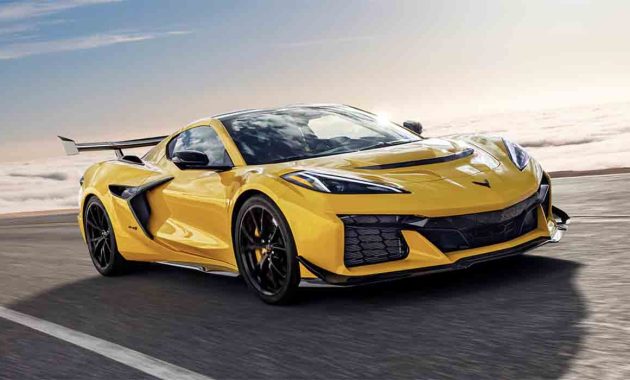

The Chevrolet Corvette ZR1 has always carried the unofficial title of “King of the Hill,” but with the arrival of the C8 generation’s ZR1 in 2025 and 2026, that title has taken on a global significance. For the first time in history, an American production car has entered the arena with the specific intent of not just competing with, but obliterating the performance figures of the most elite European hypercars. The C8 ZR1 is a monumental shift for General Motors, representing the most powerful V8 ever produced in America by a mainstream manufacturer. It is a car that moves beyond the “sports car” label and firmly into the hypercar territory, offering over one thousand horsepower from the factory with a warranty. This is the ultimate expression of the mid-engine platform that started with the C8 Stingray, now pushed to a level of mechanical aggression that was previously thought to be the exclusive domain of brands like Bugatti or Koenigsegg.
The heart of this beast is the LT7 engine, a 5.5-liter twin-turbocharged DOHC V8 with a flat-plane crankshaft. This engine is a masterpiece of thermal and mechanical engineering, building upon the architecture of the naturally aspirated LT6 found in the Z06. However, calling it a “turbocharged Z06 engine” would be a massive understatement. While it shares the same basic block casting and 5.5-liter displacement, almost every critical component of the LT7 has been redesigned to handle the immense pressures of twin-turbocharging. The LT7 utilizes a unique head casting with larger combustion chambers and specialized porting to optimize airflow. The pistons are forged aluminum with a dished top to lower the compression ratio to 9.8:1, allowing the engine to safely handle up to 24 psi of boost from its massive 76mm BorgWarner turbochargers. These turbos are integrated directly into the exhaust manifolds to minimize the distance gases must travel, which, combined with the flat-plane crank’s inherent high-revving nature, results in a twin-turbo engine that screams all the way to an 8,000 RPM redline.
The output of the LT7 is a staggering 1,064 horsepower and 828 lb-ft of torque. To put this in perspective, this single Corvette produces more power than two base-model Stingrays combined. This level of power required Chevrolet to develop an entirely new fuel system. The LT7 features a “dual-injection” setup, utilizing sixteen injectors in total—eight direct injectors for precision and eight port injectors to provide the massive volume of fuel required at full throttle. At peak performance, the fuel system can move over 1.7 gallons of high-octane gasoline every minute. To manage the heat generated by this volcanic output, the ZR1 features a revolutionary cooling suite. There are fifteen heat exchangers scattered throughout the car, including a massive “flow-through” radiator in the front hood that replaces the “frunk” storage space. This radiator is tilted and vented so that the hot air is ejected over the roof and side of the car, preventing it from entering the engine intakes or compromising the car’s aerodynamics.
Aerodynamics on the ZR1 are divided into two distinct philosophies: low-drag and high-downforce. In its standard “low-drag” configuration, the ZR1 is a top-speed monster. In October 2024, a bone-stock ZR1 reached a confirmed top speed of 233.5 mph (375 km/h), making it the fastest production car in the world priced under one million dollars. This was achieved with a “short-wing” setup that prioritizes cutting through the air with minimal resistance. However, for those who intend to dominate the racetrack, Chevrolet offers the ZTK Performance Package. This package transforms the car’s silhouette with a massive, high-mounted carbon fiber rear wing, front dive planes, and a tall “Gurney” lip on the hood. These elements work in harmony with underbody strakes to generate over 1,200 pounds of downforce at top speed. This allows the ZR1 to corner with a level of lateral grip that rivals GT3 race cars, turning the thousand-horsepower monster into a precision instrument that can be driven at the limit with total confidence.
The chassis and braking systems have been fortified to match the engine’s violence. The ZR1 features the largest brakes ever fitted to a Corvette, with 15.7-inch carbon-ceramic rotors at the front and 15.4-inch rotors at the rear. These rotors are manufactured using a new “long-strand” carbon process that improves heat dissipation and durability under extreme track use. The ZTK package further upgrades the suspension with stiffer springs and a recalibrated Magnetic Selective Ride Control 4.0 system. This system reads the road surface every millisecond and adjusts the dampers in less than the blink of an eye, ensuring the car remains stable whether it’s hitting a curb on a racetrack or cruising on a highway. The power is funneled through a heavily reinforced 8-speed dual-clutch transmission, featuring wider gears and strengthened shafts to handle the brutal torque of the LT7.
The Chevrolet Corvette ZR1 is a landmark achievement in American engineering. It is a car that challenges the global hierarchy, proving that a high-volume manufacturer can produce a vehicle with world-beating performance, exotic materials, and cutting-edge technology. It represents the summit of the internal combustion Corvette, a “King of the Hill” that doesn’t just sit on top of the mountain but owns the entire range. By combining 1,064 horsepower with active aerodynamics and a track-bred chassis, Chevrolet has created a machine that will be remembered as one of the greatest performance cars of the 21st century.
The 2026 model year marks a historic turning point for the Corvette ZR1, not just because of its 1,064-horsepower LT7 engine, but because it introduces the most significant interior redesign since the C8 was first revealed. While the early prototypes featured the polarizing “Great Wall of Buttons,” the 2026 ZR1 arrives with a completely reimagined, driver-centric cockpit that shifts the Corvette from a “performance bargain” to a legitimate luxury competitor. This phase of our analysis looks into the surgical precision of the new three-screen layout, the nostalgic return of the split-window design, and the debut of the ZR1X—the hybrid hyper-Corvette that finally breaks the 1,200-horsepower barrier.
The 2026 Cockpit: Technology Meets Craftsmanship
The interior of the 2026 ZR1 is a total departure from its predecessors. Chevrolet’s design team, led by Phil Zak, listened to customer feedback and removed the long vertical ridge of HVAC buttons that previously separated the driver from the passenger. In its place is a much more open, airy environment that utilizes a new three-screen architecture. The driver is now faced with an expansive 14-inch diagonal information center, which is complemented by a larger 12.7-inch central touchscreen tilted toward the driver. Most impressively, a new 6.6-inch auxiliary touchscreen has been added to the left of the steering wheel. This dedicated screen allows the driver to toggle Performance Traction Management (PTM) modes and view critical data like turbo boost pressure and tire temperatures without cluttering the primary displays.
The materials used in the 2026 ZR1 reflect a new commitment to “Ultimate Craftsmanship.” The 3LZ trim introduces an asymmetrical interior option, where the driver’s side can be finished in a bold Adrenaline Red while the passenger side remains in a sophisticated Jet Black. This creates a literal cockpit feel, emphasizing that the ZR1 is a driver’s tool first and foremost. New “Ultimate Suede” materials cover the headliner and pillars, while the seats—whether you choose the GT2 buckets or the hardcore Competition Sports—feature carbon-fiber halos and Napa leather. Even the technology has been upgraded with Google built-in compatibility and a new wireless charging pad integrated into the redesigned center console, ensuring the ZR1 is as capable of a cross-country road trip as it is a Nürburgring lap.
The Split-Window Heritage: Function Over Nostalgia
Visually, the most discussed feature of the 2026 ZR1 is the return of the “Split-Window.” Not seen on a production Corvette since the 1963 C2, this design choice was not made for nostalgia alone. The 1,064-hp LT7 engine generates what Chief Engineer Tadge Juechter describes as “mind-boggling” heat. The carbon fiber “spine” that splits the rear glass acts as a massive heat extractor. It is louvered to allow the boiling air from the twin-turbocharged V8 to escape the engine bay while the car is in motion. This spine works in harmony with the carbon fiber wishbone air intakes on the sides of the car, ensuring that the ZR1 can maintain its performance even after multiple high-speed runs. It is a rare example of a design element that honors a 60-year-old legend while solving a 21st-century engineering crisis.
The Arrival of the ZR1X: 1,250 HP eAWD Hypercar
Just when the world thought the ZR1 was the limit, Chevrolet unleashed the 2026 Corvette ZR1X. This is the “Zora” concept brought to life—a vehicle that combines the twin-turbo LT7 V8 with the electrified front axle from the Corvette E-Ray. By adding a 186-horsepower electric motor to the front wheels, the ZR1X achieves a combined total output of 1,250 horsepower. This hybrid setup grants the Corvette all-wheel-drive (eAWD) capabilities, allowing it to put its massive power down with surgical precision. The ZR1X can sprint from 0-60 mph in a physics-defying 1.9 seconds, putting it in the same acceleration bracket as multi-million dollar electric hypercars like the Rimac Nevera.
The ZR1X also serves as the testbed for the most advanced suspension ever fitted to a GM vehicle. It utilizes a specialized version of Magnetic Selective Ride Control 4.0 paired with an adaptive front-lift system that can adjust the car’s rake in real-time to optimize aerodynamics. To stop this 1,250-hp beast, Chevrolet equipped it with an Alcon-sourced braking system featuring 16.5-inch carbon-ceramic rotors and 10-piston calipers. For the 2026 model year, Chevrolet also introduced the “Quail Silver Limited Edition” for the ZR1X, finished in a unique Blade Silver Matte paint—the first matte production paint in Corvette history—inspired by the Inca Silver Corvettes of the late 1950s.
Conclusion: The New World Order
The 2026 Chevrolet Corvette ZR1 and its hybrid sibling, the ZR1X, represent a new world order in the supercar industry. With a starting price for the ZR1 at approximately $180,400 and the ZR1X pushing toward $210,000, these cars offer a performance-to-price ratio that is simply unmatched by European rivals. They are no longer just “fast for a Chevy”; they are among the fastest machines on the planet, period. By combining the heritage of the split-window with the futuristic power of a twin-turbo hybrid V8, Chevrolet has ensured that the Corvette remains the undisputed “King of the Hill” for the 2026 era and beyond.