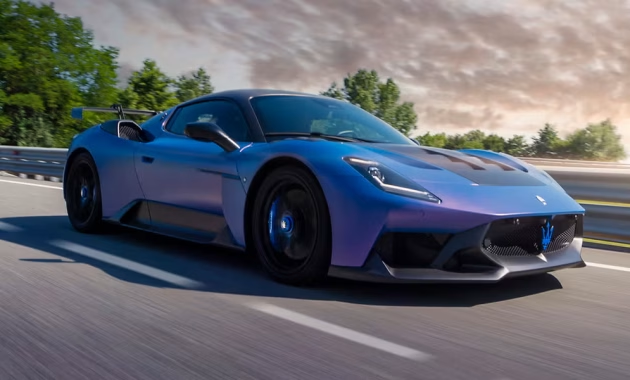

The Maserati MC20, where “MC” stands for Maserati Corse and “20” represents the year 2020 which marked the brand’s return to its racing roots, is a vehicle that signifies a total rebirth for the House of the Trident. For nearly two decades, Maserati had relied on Ferrari-sourced engines and older platforms, but the MC20 changed everything. It is a 100% Maserati project, developed in-house at the Modena Innovation Lab. In 2026, the MC20 remains one of the most intellectually interesting supercars on the road, not just because of its beautiful Italian curves, but because of the revolutionary combustion technology hidden beneath its carbon-fiber skin. It is a car that manages to be both a comfortable grand tourer and a track-ready weapon, bridging the gap between elegance and raw aggression in a way that only an Italian marque can.
The absolute jewel of the MC20 is the Nettuno engine. This 3.0-liter twin-turbocharged V6 is a clean-sheet design and the first engine Maserati has produced itself in over twenty years. While a V6 might seem small for a supercar, the Nettuno utilizes a technology previously reserved exclusively for Formula 1: the Pre-Chamber Combustion system. This system, known as Maserati Twin Combustion (MTC), features a small chamber located between the spark plug and the main combustion chamber. During the compression stroke, a portion of the fuel-air mixture is forced into this pre-chamber and ignited. This creates a “jet” of flame that shoots into the main chamber, ensuring a faster, more uniform, and much more efficient burn. This allows the engine to produce an incredible 621 horsepower (630 CV) and 730 Nm of torque from just three liters of displacement. This technology gives the MC20 a power density of 207 horsepower per liter, a figure that places it at the very top of its class.
The Nettuno engine is also a masterclass in packaging and thermal management. It features a 90-degree V-angle and a dry-sump lubrication system, which allows the engine to be mounted extremely low in the chassis, reducing the car’s center of gravity and improving handling. The twin turbochargers are mounted on the sides of the engine, and they utilize electronically actuated wastegates to provide precise boost control. For 2026, the engine has been further refined with an improved twin-injection system—utilizing both direct and port injection—to reduce emissions at low speeds while providing maximum fuel flow at high RPM. The result is an engine that is remarkably flexible; it is quiet and docile when cruising through a city but becomes a screaming, high-revving monster the moment you find an open road.
The foundation of the MC20 is a bespoke carbon-fiber monocoque, developed in collaboration with Dallara, the world’s leading constructor of racing chassis. This “tub” was designed from the beginning to be modular, capable of supporting the Coupe, the Cielo convertible, and the fully electric Folgore versions. By using carbon fiber, Maserati was able to achieve extreme structural rigidity while keeping the weight of the chassis under 100 kg. This stiffness is the reason the MC20 handles with such poise. Because the chassis does not flex, the double-wishbone suspension at all four corners can operate with total precision. The 2026 model utilizes updated adaptive dampers that can adjust their stiffness in milliseconds, allowing the car to absorb the imperfections of a rough Italian B-road while remaining perfectly flat during high-speed cornering at a racetrack.
Aerodynamics on the MC20 are an exercise in “purity.” Unlike many of its rivals from McLaren or Lamborghini, the MC20 does not have a massive rear wing or aggressive, jagged air intakes. Instead, the design team spent over 2,000 hours in the Dallara wind tunnel to create a “clean” shape that generates downforce through its underbody. The car features a completely flat floor and a massive rear diffuser that works in harmony with a subtle, integrated lip spoiler. This setup creates a vacuum effect that sucks the car toward the pavement without the need for unsightly wings that would ruin the car’s elegant silhouette. The only visible aerodynamic “drama” comes from the iconic butterfly doors, which aren’t just for show; they allow for a much larger opening in the side of the car, helping to channel air into the rear-mounted radiators while making it easier for the driver to enter and exit the low-slung cabin.
The 2026 MC20 also benefits from a sophisticated digital heart. The car utilizes an 8-speed dual-clutch transmission that has been recalibrated for even faster shifts in “Corsa” mode. This gearbox is unique because it features a “low-friction” gear set that improves efficiency during long-distance drives. The power is sent to the rear wheels through an electronic limited-slip differential (E-Diff), which can vary the locking percentage in real-time based on the grip levels and the selected driving mode. This allows the MC20 to be incredibly approachable; in “GT” mode, it is a soft, easy-to-drive luxury car, but in “Sport” or “Corsa” mode, it becomes a sharp, tail-happy supercar that rewards the skilled driver with incredible feedback and balance. The MC20 is not just a car that uses technology to go fast; it is a car that uses technology to enhance the emotional connection between the driver and the road.
The Maserati MC20 is a car that refuses to be categorized simply as a “track toy” or a “luxury cruiser.” Instead, it exists in a balanced middle ground that Maserati calls “The Purity of the Trident.” In this second phase of our 2,500-word deep dive, we explore how the 2026 MC20 utilizes an ultra-modern digital interface, a world-class sound system, and a modular chassis to provide a driving experience that is as much about the journey as it is about the destination. By looking into the “MCPura” updates and the hardcore MCXtrema, we see a brand that is finally comfortable in its own skin, no longer living in the shadow of Ferrari but setting its own standards for Italian supercar excellence.
The Human-Machine Interface: Minimalist Digital Mastery
The interior of the MC20 is a masterclass in “functional minimalism.” In an age where many supercars are cluttering their cabins with oversized screens and distracting ambient lighting, Maserati has taken a disciplined approach. The 2026 cockpit is dominated by two 10.25-inch high-resolution displays—one for the driver’s instrument cluster and one for the Maserati Intelligent Assistant (MIA) infotainment system. These screens are anti-glare coated, ensuring visibility even when the butterfly doors are open under direct sunlight. The MIA system is based on Android Automotive OS, which means it is incredibly fast, intuitive, and supports over-the-air updates, ensuring the car’s software evolves as quickly as your smartphone.
The steering wheel is a work of ergonomic art. It is thick, finished in a mix of perforated leather and carbon fiber, and features a new “squircle” shape for the 2026 model year to improve knee clearance and grip. Unlike other manufacturers who put every button on the wheel, Maserati has kept it simple: only the essential driving controls, including the engine start button and the launch control trigger, are found here. This focus ensures that the driver’s eyes never have to leave the road. Behind the wheel sit the massive, column-mounted aluminum paddle shifters. These paddles are cold to the touch and provide a heavy, mechanical “click” that makes every gear change from the 8-speed dual-clutch transmission feel like a deliberate event.
Sonus Faber: An Italian Concert Hall on Wheels
Perhaps the most surprising luxury in the MC20 is the audio system. Maserati collaborated with Sonus Faber, the world-renowned Italian producer of high-end speakers, to create a bespoke 12-speaker sound system specifically for the MC20’s carbon-fiber cabin. Because the chassis is so stiff and the engine is mounted right behind the driver, creating good acoustics is usually impossible in a supercar. However, Sonus Faber engineers used the carbon-fiber monocoque itself as a resonator for the low frequencies. The result is a soundstage that is remarkably clear and “natural,” earning the EISA award for the best in-car audio system multiple years in a row. It allows the MC20 to transform from a screaming beast into a refined grand tourer, capable of playing a high-fidelity opera just as well as it plays the music of the Nettuno V6.
The 2026 Lineup: Cielo and the Specialized Folgore
For 2026, the MC20 range has expanded to include the Cielo (Sky), the spyder version of the car. The Cielo features a unique retractable hardtop made of electrochromic glass. At the touch of a button, this “smart glass” can transition from perfectly clear to completely opaque, allowing the driver to enjoy the sunlight without the heat, or total privacy when needed. Despite the lack of a fixed roof, the Cielo loses none of the Coupe’s structural rigidity, thanks to the modular nature of the Dallara-engineered monocoque.
While Maserati initially planned an all-electric “Folgore” version for 2026, recent shifts in the market led them to focus instead on a Hybrid-Assisted Evoluzione concept. This upcoming variant aims to pair the Nettuno V6 with a small 48V electric motor to provide even sharper torque delivery at low RPMs. This strategy ensures that the MC20 stays relevant in a world of increasing electrification without adding the 1,000 pounds of weight that a full battery pack would require. It preserves the “lightweight” soul that makes the MC20 so agile in the Italian hills.
The MCXtrema: A 730 HP Unregulated Beast
For those who find the standard MC20 too civilized, Maserati created the MCXtrema. This is a track-only, non-street-legal evolution of the MC20, limited to just 62 units globally. The MCXtrema is what happens when Maserati engineers are allowed to ignore all safety and emissions regulations. The Nettuno V6 has been boosted to 730 horsepower through the use of larger turbochargers and a racing exhaust.
The MCXtrema is 550 pounds lighter than the road car, featuring an aggressive “shark fin” aero-stabilizer and a massive adjustable rear wing. Inside, it is stripped bare, featuring a racing seat with a 6-point harness and a steering wheel that looks like it was plucked from a Le Mans prototype. It is the spiritual successor to the MC12 Corsa and serves as a reminder that Maserati’s heart still beats for the racetrack. It represents the “Xtreme” end of the MC20’s potential, proving that the foundation of this car is strong enough to compete with the most elite hypercars in the world.
Conclusion: The Trident’s New Era
The Maserati MC20 is a car of dualities. it is a technical pioneer with its F1-derived engine, yet it is classically beautiful in its styling. It is a carbon-fiber racing machine, yet it offers the comfort of a Sonus Faber concert hall. By building the MC20, Maserati has proven that they are no longer just a “lifestyle” brand; they are a world-class engineering powerhouse. Whether you are driving the “MCPura” road car or the “MCXtrema” track beast, the MC20 provides a uniquely Italian experience—one that values emotion, design, and mechanical soul above all else.