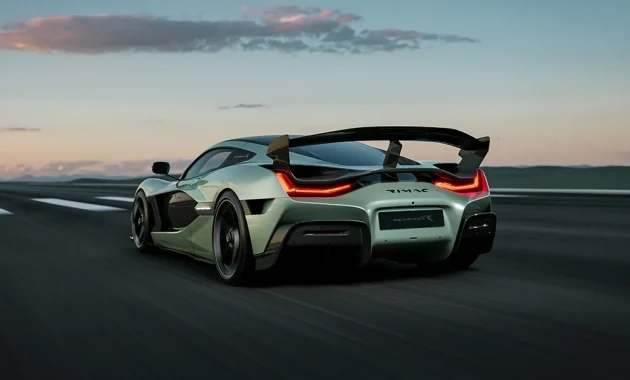

The Rimac Nevera is named after a sudden, powerful Mediterranean storm that races across the Croatian coast, charged by lightning. It is a fitting title for a car that has single-handedly ended the debate over whether electric vehicles can compete with the world’s greatest internal combustion engines. In 2026, the Nevera is no longer just a “fast EV”; it is the benchmark against which every hypercar on this list is measured. With the introduction of the Nevera R, Mate Rimac’s team has pushed the boundaries of what is possible with electrons. This version moves the Nevera from a “Hyper GT” into a focused “Hyper Sports Car,” prioritizing lateral grip and track dominance over pure straight-line cruising. It is a 2,107-horsepower statement that the future of speed has already arrived, and it is silent, surgical, and absolutely relentless.
The core of the Nevera R’s devastating performance is its second-generation quad-motor powertrain. While the standard Nevera was already a world-beater with 1,914 horsepower, the “R” variant utilizes a new 108 kWh battery pack and upgraded inverters to push the output to a staggering 2,107 horsepower (2,140 PS). Each wheel is driven by its own independent, carbon-sleeved permanent-magnet motor. This allows for a level of control that no mechanical differential could ever hope to achieve. Through Rimac’s All-Wheel Torque Vectoring (R-AWTV) system, the car calculates the optimal power distribution 100 times per second. If you enter a corner too fast, the car doesn’t just brake; it can apply “negative torque” to the inside wheels while rocket-launching the outside wheels, effectively bending the laws of physics to rotate the 2,300 kg machine around the apex.
The performance figures associated with the 2026 Nevera R are almost difficult to comprehend. It has officially claimed the title of the fastest accelerating production car in the world, with a 0-60 mph time of just 1.66 seconds (using a one-foot rollout). The 0-100 km/h sprint is dispatched in 1.72 seconds, and it reaches the 300 km/h (186 mph) mark in a mind-blowing 7.89 seconds. To put that in perspective, by the time a standard high-performance sports car has reached highway speeds, the Nevera R is already approaching the takeoff speed of a commercial airliner. In July 2025, the Nevera R set 24 new world records in a single day, including a standing quarter-mile time of 7.90 seconds, making it the first production car to officially break into the 7-second bracket.
A critical part of this performance comes from the new battery architecture. The 108 kWh liquid-cooled battery is integrated directly into the carbon fiber monocoque, serving as a structural member that increases the car’s torsional rigidity. For the 2026 “R” model, Rimac utilized a new cell chemistry that allows for higher peak power discharge and better thermal management. This ensures that the car doesn’t “throttle back” its power after one or two hard runs. The battery system also supports ultra-fast 500 kW DC charging, capable of taking the car from 0 to 80% charge in less than 20 minutes. This level of technical maturity proves that Rimac is not just a car manufacturer, but a world-leading technology firm that provides battery and powertrain solutions to the likes of Porsche, Aston Martin, and Koenigsegg.
Aerodynamics on the Nevera R have been radically overhauled to manage its increased power. While the original Nevera was designed with a smooth, “slippery” aesthetic for top-speed runs, the R features a massive fixed rear wing and a significantly enlarged rear diffuser. These elements, combined with a deeper front splitter and active aero flaps in the underbody, increase downforce by 15% and improve aerodynamic efficiency by 10%. This ensures that the car remains “pinned” to the track during high-speed cornering. The top speed is limited to 350 km/h for standard use, but under controlled manufacturer supervision, the Nevera R has verified a top speed of 431 km/h (268 mph), officially making it the fastest production electric vehicle on the planet as of January 2026.
Stopping a 2,107-horsepower electric titan requires a braking system of astronomical proportions. The Nevera R is equipped with the latest EVO2 carbon-ceramic brakes featuring a specialized silicone matrix layer for improved thermal durability. These brakes work in a seamless “blended” dance with the motors’ regenerative braking. In high-speed deceleration, the motors act as generators, pumping up to 300 kW of energy back into the battery while providing a massive braking force before the physical pads even touch the discs. This “brake-by-wire” system is so advanced that Mate Rimac famously claimed the car is the only one in the world that can accelerate faster than it can brake. The 2026 Nevera R is a vehicle that defies the traditional limitations of weight and energy, proving that in the hands of the right engineers, the electric motor is the ultimate tool for total automotive dominance.
The Rimac Nevera R is as much a supercomputer as it is a hypercar. While Phase 1 was about the raw, earth-shaking power of 2,107 horses, Phase 2 is about the intelligence required to tame that power. In 2026, Rimac has integrated an “AI Driving Coach” and a digital interface that changes the relationship between driver and machine. Beyond the software, the brand is celebrating its 15th year of “achieving the impossible” with the most exclusive collector editions in its history. This is where the Nevera stops being a vehicle and starts becoming a “passport” into the inner circle of automotive’s most innovative genius, Mate Rimac.
The AI Driving Coach: A Digital Instructor at 250 MPH
The Nevera R features the world’s first AI-driven on-board driving coach. Utilizing 13 cameras, 6 radars, and 12 ultrasonic sensors, the car’s “NVIDIA Pegasus” supercomputer builds a real-time, 3D map of the environment. When you take the Nevera R to a racetrack, the AI Coach becomes your co-pilot. It doesn’t just record data; it provides real-time audio and visual guidance through the digital cockpit. It tells you exactly when to brake, where the optimal apex is, and how much torque to apply to exit a corner perfectly. It is designed to help drivers explore the 2,107-horsepower limit safely, effectively gamifying the track experience to improve the owner’s skill with every lap.
The Digital Cockpit: Minimalism and Machined Metal
The interior of the 2026 Nevera is a blend of high-tech screens and high-touch craftsmanship. Three high-definition screens provide a “wraparound” data experience. The driver’s display focuses on performance telemetry, while the central 10.25-inch screen handles the infotainment and the proprietary “Rimac M2M” (Machine to Machine) connectivity. The third screen is located directly in front of the passenger, displaying speed and G-force in real-time so they can share in the sensation of 1.66-second acceleration.
What sets the Nevera apart from other EVs is its use of physical, machined-aluminum dials. These “analog” controls have small integrated screens that allow the driver to rotate between seven different driving modes—ranging from “Range” (for efficiency) and “Comfort” to the radical “Drift Mode.” In Drift Mode, the front motors are de-emphasized while the rear motors provide a massive torque split, allowing the car to perform smoking, high-angle slides with the precision that only an electric drivetrain can offer.
The 15th Anniversary Edition: A Copper Celebration
To honor 15 years since Mate Rimac began converting an old BMW 3-series into an electric race car in his garage, Rimac released the 15th Anniversary Edition for 2026. Limited to just nine units globally, this edition is finished in a unique matte copper paint—a color chosen because copper is the most widely used material in electrical cabling, representing the “energy” of the brand. These cars feature visible carbon fiber splits, copper-anodized switchgear, and bespoke “2009–2024” embroidery on the armrests. At a price of $2.5 million, these nine cars were sold out instantly, each coming with a matching set of bespoke luggage and an invitation to the 2026 Goodwood Festival of Speed.
The Founder’s Edition: The “Golden Ticket” to Zagreb
The most extreme expression of exclusivity is the Nevera R Founder’s Edition, limited to only ten units. This is not just a car; it is a permanent “access pass” to the Rimac headquarters in Croatia. Each of the ten owners was hand-selected and personally invited to configure their car at the Rimac Campus alongside Mate Rimac himself.
The Founder’s Edition features a two-tone design that follows the car’s natural geometry, making it look visually lower and more aggressive without the need for loud graphics. The interior features an asymmetrical seat layout—matching Mate’s personal car—and door panels embroidered with the three key dates of Rimac’s history: the garage era, the Concept_One launch, and the Nevera record-breaking era. Owners of this edition receive a “Company Card” that grants them 24/7 access to the factory and involves them in actual R&D strategy discussions for future Rimac models. It is the ultimate level of automotive luxury: the luxury of influence.
Conclusion: The Future belongs to the Fast
The Rimac Nevera R is the final proof that the electric age is not about the loss of emotion, but the gain of a new kind of intensity. It is a car that can outperform a Formula 1 car in a straight line, coach you through a racetrack like a professional instructor, and then drive you home in silent, air-conditioned luxury. In 2026, as the internal combustion era reaches its final peak, the Nevera R stands at the beginning of a new mountain range. It is the definitive hypercar of the 21st century—a Croatian lightning storm that has changed the world forever.