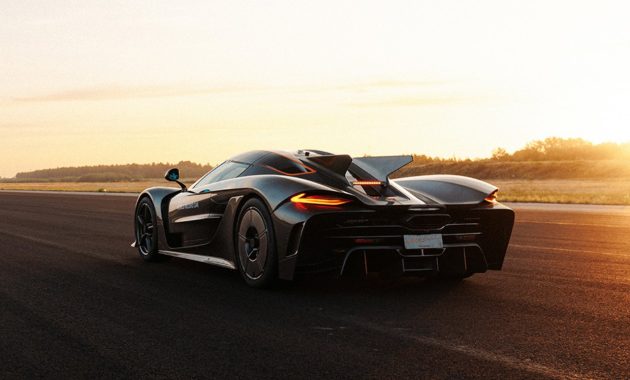

The Koenigsegg Jesko Absolut is the ultimate realization of Christian von Koenigsegg’s dream: to create the fastest production car the world has ever seen. While the “Jesko Attack” is built for track times and high downforce, the “Absolut” is a streamlined predator designed for a single purpose—straight-line velocity. In 2026, as Bugatti shifts toward naturally aspirated V16 hybrids, Koenigsegg remains a master of the turbocharged V8, refining a platform that produces more power-per-liter than almost any other engine on Earth. The Jesko Absolut is a car that exists in the realm of theoretical physics, where air becomes as thick as water and the only limit to speed is the structural integrity of the tires.
The heart of the Jesko Absolut is a 5.1-liter twin-turbocharged V8. This is not just a carry-over from the Agera; it is a ground-up redesign featuring the world’s lightest V8 crankshaft. Weighing just 12.5 kg, this 180-degree flat-plane crank allows the engine to rev to 8,500 RPM with the ferocity of a superbike. When running on standard 95-octane gasoline, the engine produces a massive 1,280 horsepower. However, when fueled with E85 biofuel, the output jumps to a staggering 1,600 horsepower and 1,500 Nm of torque. To eliminate turbo lag, Koenigsegg developed a patent-pending air-injection system. A 20-liter carbon fiber tank shoots a 20-bar blast of air directly into the turbochargers to “pre-spool” them, ensuring that the 1,600 horses are available the millisecond the driver touches the throttle.
Translating this volcanic power to the rear wheels is the Koenigsegg Light Speed Transmission (LST). This is arguably the most advanced gearbox ever fitted to a car. Unlike a traditional Dual-Clutch Transmission (DCT), which can only shift to adjacent gears (e.g., 4th to 5th), the LST features a multi-clutch design with nine forward speeds. It can jump from any gear to any other gear instantly. If you are cruising in 7th and need maximum acceleration, the Ultimate Power on Demand (UPOD) system skips 6th and 5th, shifting directly into 4th in a matter of milliseconds. Weighing only 90 kg, it is significantly lighter and smaller than the DCTs used by rivals, allowing the Jesko to maintain a power-to-weight ratio that is better than 1:1.
Aerodynamically, the Absolut is the antithesis of the Jesko Attack. Every wing and spoiler that creates drag has been removed. In place of the Attack’s massive rear wing are two vertical fins inspired by the F-15 fighter jet. These fins stabilize the car at extreme speeds by cleaning up the airflow over the rear deck. The rear hood has been extended by 85mm to create a “Longtail” effect, keeping the air attached to the body for as long as possible. The rear wheels feature removable “dish” covers to further reduce turbulence. The result of these thousands of hours of CFD (Computational Fluid Dynamics) modeling is a drag coefficient of just 0.278 Cd. This is the magic number that Koenigsegg believes will allow the Jesko Absolut to break the 531 km/h (330 mph) barrier, officially crowning it as the fastest car in human history.
The chassis of the Jesko is a carbon fiber monocoque that is the stiffest in the industry, measured at 65,000 Nm per degree. To manage the immense forces of high-speed driving, Koenigsegg utilized a Triplex Suspension system at both the front and rear. This third horizontal damper prevents the car from “squatting” under the massive aerodynamic loads and acceleration, ensuring the ride height remains perfectly constant. The car also features active rear-wheel steering, which makes this long-tail hypercar feel as nimble as a city car in tight corners. Every component, from the carbon fiber wishbones to the hollow-core carbon fiber wheels, is designed to minimize unsprung mass, allowing the Michelin Pilot Sport Cup 2 tires to maintain a perfect contact patch with the road.
The Koenigsegg Jesko Absolut is a car of superlatives. It is a vehicle where every nut and bolt has been scrutinized to see if it can be made lighter or stronger. It is a testament to the fact that internal combustion, when pushed to its absolute limit, can still outperform almost anything else on the planet. For the few individuals who will ever sit behind the wheel of an Absolut, the experience is not just about driving; it is about witnessing the absolute limit of what is possible on four wheels.
f the engine of the Jesko Absolut is the heart of a beast, the interior and the “Autoskin” body are the brain and nervous system. Koenigsegg has always been a brand that prioritizes the “Human-Machine Interface,” and for 2026, they have elevated this to a level that feels more like science fiction than automotive reality. Every surface of the Jesko Absolut is designed to interact with the driver and the environment with total intelligence. This is a car where you don’t just “get in”; you enter a carbon-fiber sanctuary that is constantly recalibrating itself to ensure you remain safe, comfortable, and in control while traveling at speeds that would blur the vision of a fighter pilot.
The Dihedral Synchro-Helix Doors and Autoskin
The first experience of the Jesko Absolut begins before you even touch the car. It features the latest version of the Dihedral Synchro-Helix Door Actuation System. These iconic doors have been redesigned for the Jesko to open with a more outward-and-upward arc. This allows for easier access to the cabin even when parked next to high curbs. But the real magic lies in the Autoskin system. Using a series of ultra-lightweight hydraulic actuators, the car can open its doors, front hood, and rear engine cover automatically at the press of a button on the key fob.
To prevent these automated panels from hitting obstacles, Koenigsegg integrated proximity sensors into the bodywork. If the car detects a wall or another vehicle, it will halt the door’s movement instantly. This system adds less than 5 kg to the car’s weight but adds a level of theater and convenience that is unmatched in the hypercar world. It transforms the Jesko from a static object into a living, breathing machine that “greets” its owner upon arrival.
The SmartWheel and SmartCluster: A Rotating Revolution
Inside the cabin, the most striking feature is the SmartWheel. The steering wheel features two small haptic touchscreens embedded into the horizontal spokes. These screens allow the driver to control audio, phone calls, ride height, and the front-axle lift system with simple thumb swipes. To prevent accidental inputs during aggressive cornering, the screens provide haptic feedback, giving the driver a physical “click” sensation when a command is accepted.
Directly behind the wheel is the SmartCluster, a 5-inch digital instrument binnacle. What makes this cluster unique is that it is mounted directly to the steering column, meaning it rotates with the wheel. However, through a clever piece of software engineering, the digital graphics—the speedometer, the G-meter, and the tachometer—remain perfectly level and upright even when the wheel is turned 90 degrees. This ensures that the most critical information is always in the driver’s line of sight, regardless of how much steering lock is applied. At the center of the dashboard sits the 9-inch SmartCenter touchscreen, which handles the more complex vehicle settings and Apple CarPlay, all powered by an in-house developed software framework.
The Quest for 330 MPH: Simulating the Impossible
As of early 2026, the Jesko Absolut remains the “Theoretical King.” While it has already shattered world records for acceleration—completing the 0-400-0 km/h (0-249-0 mph) run in a staggering 25.21 seconds—the ultimate top speed run has yet to be officially clocked. Koenigsegg’s internal simulations, which have historically been incredibly accurate, suggest that the car is capable of reaching 531 km/h (330 mph). The primary barrier to proving this isn’t the car’s power or its 0.278 Cd drag coefficient; it is finding a road long and flat enough to safely allow for such a run.
Michelin has played a vital role in this quest, verifying that the Pilot Sport Cup 2 R tires can withstand the immense centrifugal forces of 330 mph. During testing at a laboratory in Nevada, these tires were spun to speeds exceeding 500 km/h without structural failure. Christian von Koenigsegg has stated that the company is currently scouting locations—likely a closed-off public highway in the United States or a specialized military runway in Europe—to finally put the “theoretical” debate to rest. For now, the Jesko Absolut holds the record as the fastest gas-powered car in the quarter-mile (8.88 seconds), but the world is waiting for the moment it finally claims the absolute top speed crown.
Conclusion: The Ultimate Peak of Internal Combustion
The Koenigsegg Jesko Absolut is more than just a speed machine; it is a declaration of independence from the standard rules of automotive production. By building its own engines, its own transmissions, and its own software, Koenigsegg has created a vehicle that is a pure expression of one man’s vision. It is a car that uses 3D-printing and AI-optimized materials to reach speeds that were unthinkable just a decade ago. In the 2026 landscape, the Jesko Absolut stands as the final, most extreme evolution of the internal combustion hypercar—a 1,600-horsepower ghost that haunts the dreams of every other manufacturer on this list.