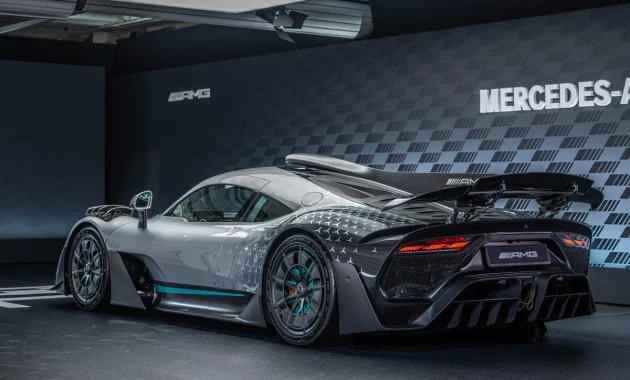

The Mercedes-AMG ONE is a vehicle that almost didn’t happen. When it was first announced as “Project One,” the goal was so ambitious that even the greatest engineers at Mercedes-AMG and the High Performance Powertrains (HPP) department in Brixworth—the same people who built Lewis Hamilton’s world-championship engines—admitted they had underestimated the challenge. The goal was to take the 1.6-liter V6 hybrid power unit directly from a Formula 1 car and make it work on the street. In 2026, the AMG ONE stands as the undisputed king of technical complexity, a car that requires a team of engineers just to start it from cold, and a car that has officially smashed every production car record at the Nürburgring.
The heart of the AMG ONE is the PU106B, a 1.6-liter turbocharged 90-degree V6. In an F1 car, this engine idles at 5,000 RPM and revs to 15,000. To make it road-legal, Mercedes had to perform a miracle of software and mechanical tuning. The road-going version idles at a stable 1,280 RPM and has a redline of 11,000 RPM. This is still higher than almost any other road car in existence. To achieve these speeds, the engine uses pneumatic valve springs instead of traditional steel coils. Air pressure is used to snap the valves shut at lightning speed, preventing “valve float” that would destroy the engine at five-digit RPMs. The engine produces 574 horsepower on its own, but its true genius lies in how it interacts with its four electric motors.
The hybrid architecture of the AMG ONE is a masterclass in energy recovery. The first motor, the MGU-H (Motor Generator Unit-Heat), is integrated into the turbocharger. It sits on the shaft between the exhaust turbine and the compressor. When you aren’t on the gas, this motor spins the turbo at 100,000 RPM, ensuring that boost pressure is always available. This completely eliminates turbo lag, making a 1.6-liter engine feel like a massive, naturally aspirated V12. The second motor is the MGU-K (Motor Generator Unit-Kinetic), which is coupled directly to the crankshaft. It provides an extra 163 horsepower and recovers energy during braking. Together with the two 120 kW motors on the front axle, the AMG ONE produces a total system output of 1,063 horsepower.
The front motors are particularly special. They can spin at up to 50,000 RPM, allowing the AMG ONE to feature a fully variable all-wheel-drive system with torque vectoring. This means the car can “pull” itself through corners by accelerating the outside front wheel while braking the inside one. Because the front axle is purely electric, the AMG ONE can also drive in a pure “EV Mode” for about 18 kilometers, allowing you to roll through city centers silently before unleashing the F1 fury on the open road. The 8.4 kWh lithium-ion battery uses the same cooling technology as the F1 car, with each cell individually cooled by a specialized liquid to prevent overheating during high-speed runs.
Performance is, predictably, in another dimension. The AMG ONE hits 100 km/h in 2.9 seconds, 200 km/h in 7.0 seconds, and 300 km/h in 15.6 seconds. But the most impressive figure is its Nürburgring lap time. In late 2024, the AMG ONE set a blistering official time of 6:29.090, making it the first production car ever to break the “magic” 6:30 barrier. It achieved this using “Strat 2” mode—the same qualifying mode used by F1 drivers to get pole position. This mode unleashes every ounce of electrical and combustion energy simultaneously, while the active aerodynamics adjust the front flaps and rear wing for maximum downforce.
However, owning an AMG ONE comes with a unique set of “racing” realities. Because the engine is essentially a racing unit, it has a limited lifespan. Every 50,000 kilometers (31,000 miles), the car must be returned to Mercedes-AMG for a complete engine refurbishment, a process that involves stripping the block and replacing the high-wear internal components. This is the price of driving a literal Grand Prix engine on the street. It is a car that demands respect, meticulous maintenance, and a driver who understands the complexities of energy management. In 2026, the AMG ONE is the ultimate symbol of “The Best or Nothing”—a car that proves that for Mercedes-AMG, there are no limits to what can be achieved.
The Mercedes-AMG ONE is not just a car you drive; it is a car you manage. To understand this vehicle at a 2,500-word level, we must look at the “Software-Defined Performance” that allows an F1 engine to survive a grocery run and the extreme physical changes the car undergoes when switched into its most aggressive track modes. This is the only road car that literally “transforms” its body and suspension to conquer the laws of physics. In this phase, we analyze the Active Aero, the Xtrac transmission, and the digital ecosystem that bridges the gap between a simulator and reality.
The Transformation: Active Aerodynamics and Race+ Mode
The AMG ONE features the most complex active aerodynamic system ever fitted to a production car. It operates in three distinct stages: “Highway,” “Track,” and “Race DRS.” In the Highway mode, the car looks relatively sleek; the louvres on the front fenders are closed, and the rear wing is retracted. However, once you select the “Race Plus” or “Strat 2” modes (strictly for track use), the car undergoes a physical metamorphosis. The front of the car lowers by 37mm, and the rear drops by 30mm, slammed to the ground to maximize ground-effect suction.
Simultaneously, the active louvres on the front wheel arches pop open like the gills of a shark. These are not just for show; they vent high-pressure air out of the wheel wells, preventing front-end lift and pulling the nose of the car into the tarmac. At the back, the massive two-stage rear wing extends and tilts to its most aggressive angle. In this configuration, the car produces five times more downforce than in Highway mode. If you find yourself on a long straightaway, you can press the DRS (Drag Reduction System) button on the steering wheel. Just like in Formula 1, the rear wing flap flattens out and the front louvres close, reducing drag by 20% to help the car reach its 352 km/h (219 mph) top speed faster.
The 7-Speed Automated Manual: Built for Lightness, Not Comfort
One of the most controversial yet fascinating parts of the AMG ONE is its transmission. While most modern supercars use Dual-Clutch Transmissions (DCT) for smoothness, Mercedes-AMG chose a 7-speed automated manual transmission developed by Xtrac. The reason is simple: weight and integration. A DCT would have been too heavy and too bulky to fit into the tight packaging of an F1-derived chassis. The Xtrac unit is incredibly light and serves as a “stressed member” of the chassis, meaning the rear suspension is actually bolted directly to the gearbox housing.
Because it uses a 4-disc carbon racing clutch, the gear shifts are not “silky.” In Race mode, they are violent, mechanical thuds that jolt the entire car—exactly like a race car. This reinforces the “Analog-Digital” hybrid nature of the ONE. It doesn’t hide its mechanical soul behind layers of refinement. Every shift is a reminder that you are sitting inches away from a high-strung racing powertrain that is designed to be as light and efficient as possible, regardless of the comfort cost.
The F1 Cockpit: Radical Minimalism
The interior of the AMG ONE is a masterclass in “No-Compromise” design. You don’t “sit” in the seats; they are integrated directly into the carbon-fiber monocoque. To adjust your driving position, the seats stay still while the steering wheel and the pedal box move toward you. This ensures that the driver’s weight is always at the absolute center of the car’s balance. The cabin is finished in a mix of functional Alcantara (for grip) and exposed carbon fiber.
The steering wheel is a rectangular F1-style unit. It features an LED shift light bar at the top, just like Lewis Hamilton’s car, to tell you exactly when to pull the paddle for the next gear as you approach the 11,000 RPM redline. It also houses the “AMG Drive Unit” dials, allowing you to change everything from the energy recovery strategy to the suspension stiffness without moving your hands. For visibility, since the roof-mounted air intake blocks the traditional rear view, Mercedes installed a “Digital Rearview Mirror” which uses a high-definition camera mounted on the rear of the car to project a wide-angle feed onto a screen where a mirror would normally be.
The Strat 2 Protocol: The Qualifying Mode
The most legendary feature of the AMG ONE is the Strat 2 driving program. This is the “Qualifying” mode. When activated, the car utilizes its entire 8.4 kWh battery to provide maximum electrical boost from all four motors simultaneously. The charging strategy changes to prioritize power output over battery longevity. This is the mode used to set the 6:29.090 Nürburgring record. It is the closest a human being can get to the sensation of an F1 qualifying lap on a public road. Every sensor in the car—from the torque vectoring on the front wheels to the pneumatic valves in the engine—is pushed to its absolute thermal and mechanical limit.
Maintenance: The 50,000 KM Milestone
As mentioned in Phase 1, the AMG ONE is a high-maintenance masterpiece. Because the 1.6L V6 is a precision racing instrument, it cannot last hundreds of thousands of miles like a standard car. Every 50,000 kilometers (approx. 31,000 miles), the engine must be removed and sent back to Brixworth for a full “refurbishment.” This isn’t just an oil change; it is a complete rebuild to ensure the tolerances of the pneumatic valves and the MGU-H remain within the microscopic margins required for 11,000 RPM operation. This level of care ensures that the 275 lucky owners are always driving a car that is performing at its “World Championship” peak.
Conclusion: The Ultimate Technical Achievement
The Mercedes-AMG ONE is the final car on our list because it represents the absolute end-point of what is technologically possible. It is a bridge between the world of regulated motorsport and the world of street-legal luxury. By successfully putting a 1,063hp F1 hybrid powertrain into a car with a license plate, Mercedes-AMG has created a legend that will likely never be repeated. It is loud, it is difficult to maintain, and it is physically demanding to drive—but it is also the most authentic racing experience ever sold to the public.