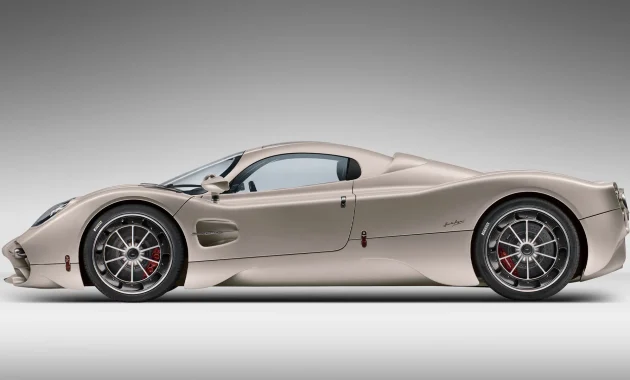

The Pagani Utopia Roadster represents the pinnacle of Horacio Pagani’s “C10” project, a car that took over six years of development to reach perfection. While other manufacturers are moving toward hybridization and heavy battery packs, Pagani has stayed loyal to his core principles: simplicity, lightness, and the pleasure of driving. The Utopia Roadster is not just a car; it is a mechanical sculpture designed to be timeless. In 2026, it stands as one of the few remaining hypercars that offers a pure, naturally aspirated feel from a twin-turbo V12 and, crucially, a genuine manual transmission. It is the successor to the Zonda and the Huayra, completing a trilogy of Italian masterpieces that prioritize emotion and craftsmanship over clinical performance figures.
The soul of the Utopia Roadster is the “Pagani V12,” a 6.0-liter 60-degree twin-turbocharged engine developed exclusively for Pagani by the engineers at Mercedes-AMG. This engine is a marvel of old-school engineering blended with modern metallurgy. It produces a monumental 864 horsepower (635 kW) and a staggering 1,100 Nm of torque available from just 2,800 RPM. Unlike the high-revving V12s in Ferraris that require you to “work” for the power, the Pagani engine offers a “fat” torque curve that provides explosive acceleration in any gear. Every single engine is hand-assembled by a single craftsman at the AMG facility in Affalterbach, and for the Utopia, it features unique bronze valve covers and a lightweight design that tips the scales at just 262 kg. There are no batteries here, no electric motors—just the raw, unadulterated roar of twelve cylinders breathing through Pagani’s iconic quad-tip titanium exhaust.
Perhaps the most impressive feat of the Utopia Roadster is its weight. Typically, when a manufacturer removes the roof of a car, they must add heavy steel or carbon reinforcements to the chassis to maintain rigidity, often adding 100 kg or more to the vehicle. Pagani, however, has achieved the impossible: the Utopia Roadster weighs exactly the same as the Coupe, at a featherweight 1,280 kg (2,822 lbs) dry. This was achieved by redesigning the entire monocoque using advanced composite materials like Carbo-Titanium HP62 G2 and Carbo-Triax HP62. These materials utilize a weave of carbon fiber and titanium threads to provide immense strength without the bulk of traditional carbon fiber. The result is a car that is as stiff as a closed-cockpit racer but offers the infinite headroom of an open-top roadster.
The drivetrain is a tribute to the “purist” driver. While a 7-speed automated manual transmission (AMT) by Xtrac is available for those who want lightning-fast shifts, the majority of Utopia buyers opt for the 7-speed pure manual. This is a 21st-century rarity—a manual gearbox capable of handling 1,100 Nm of torque. It uses a triple-disc clutch to ensure the pedal isn’t too heavy for daily use, while the gear lever itself is a piece of jewelry. The linkage is entirely exposed, allowing the driver to see the mechanical dance of the titanium rods as they slot into place. This connection between man and machine is the very heart of the Pagani philosophy; it isn’t about the fastest lap time, it is about the tactile sensation of every gear change.
Aerodynamics on the Utopia Roadster are “invisible.” Horacio Pagani famously hates “vulgar” wings and appendages that ruin the lines of a car. Instead, the Utopia uses an organic shape that channels air through the bodywork. Air is guided through the front wheel wells to cool the massive Brembo carbon-ceramic brakes and then channeled around the mirrors and over the teardrop-shaped roof. At the rear, two “active flaps” are harmoniously integrated into the trailing edge of the body. These flaps adjust their angle independently to optimize downforce or stability depending on the car’s speed and steering angle. This “passive-active” system ensures the car remains stable at its electronically limited top speed of 350 km/h (217 mph) without ever needing a fixed rear wing.
The suspension is equally advanced, featuring forged aluminum double wishbones that were developed based on the data gathered from the track-only Huayra R. The dampers are electronically controlled, allowing the car to transition from a comfortable “Grand Tourer” on the streets of Modena to a stiff, precise instrument on a mountain pass. For the 2026 model year, Pagani also introduced the “Cyber Tyre” system in collaboration with Pirelli. Each tire contains a sensor that communicates directly with the car’s ABS and stability control systems, providing the computer with real-time data on tire temperature and grip levels. This ensures that the 864 horses are always managed with the highest degree of safety and precision, making the Utopia Roadster as technologically advanced as it is beautiful.
If the exterior of the Utopia Roadster is a sculpture of air and carbon, the interior is a tribute to the mechanical clockmakers of the Renaissance. Horacio Pagani has always believed that a car should be a “work of art” that can be sat in, and for the Utopia Roadster, he has effectively declared war on the modern digital screen. In a 2026 landscape dominated by “hyperscreens” and software-defined cockpits, the Utopia Roadster offers a “Digital Detox.” It is a space where every touchpoint is cold aluminum, warm leather, or polished carbon. This phase of our analysis looks into the 28-hour steering wheel, the exposed “gated” shifter, and the bespoke Sport Pack that turns the Roadster into a high-performance jewelry box.
The 28-Hour Steering Wheel: A Monolithic Masterpiece
The steering wheel of the Utopia Roadster is perhaps the most expensive and time-consuming single component found in any car cabin today. It is not assembled from various parts; it begins life as a massive, solid 94.8-pound (43 kg) block of aircraft-grade aluminum. A specialized five-axis milling machine then spends 28 hours of continuous, surgical cutting to hollow out the metal and create the intricate spokes and rim.
Once the machine is finished, the wheel weighs a mere 3.53 pounds (1.6 kg). It is then hand-polished for an additional eight hours to achieve a perfect satin sheen that no robot can replicate. The wheel is finished with hand-stitched leather grips, but the center remains a raw, metallic testament to Pagani’s obsession with “the beauty of the machine.” This wheel doesn’t just steer the car; it serves as the primary tactile connection to the 864-horsepower V12, vibration-free and structurally perfect.
The “Neoclassical” Instrumentation: Clockmaker Precision
The dashboard of the Utopia Roadster is a defiant rejection of the LED screen. While there is a single, small digital display directly in front of the driver for the backup camera and navigation, the primary information is relayed through classic analog gauges. These four central dials—tracking oil pressure, water temperature, fuel, and boost—are designed to resemble high-end Swiss watches.
The needles are balanced with microscopic weights, and the backlighting is achieved through subtle, indirect LEDs that make the aluminum dials glow like a nocturnal cityscape. The toggles on the center console are made of solid metal, providing a heavy, satisfying “clink” with every activation. Even the key fob has been redesigned to echo the car’s open-body profile, carved from a single piece of aluminum. The result is a cabin that doesn’t feel like a piece of consumer electronics, but like a timeless instrument that will be just as functional and beautiful in fifty years as it is today.
The Sport Pack: Carbo-Titanium Extremity
For the 2026 model year, Pagani introduced the Sport Pack, an optional configuration that was featured on the Habanero Red debut car. This package is for the owner who wants to maximize the “Carbo-Titanium” experience. It replaces standard interior components with Pagani’s patented weave, specifically for the seat structures and the gear shifter.
The Sport Pack seats utilize a 20% lighter padding and a specialized “Grecale” leather pattern, while the exterior of the car receives active aero flaps and wheel deflectors made of the same titanium-infused carbon. The pack also includes a titanium exhaust system that is 30% lighter than the standard unit, tuned to provide a more “operatic” scream at high RPM. This package isn’t just about weight saving; it is about the visual and tactile celebration of the world’s most advanced composite materials, shimmering with the unique blue-grey tint of raw titanium.
The Dual-Top Strategy: Hardtop vs. Soft-top
The Utopia Roadster is designed to handle any environment. It comes with a carbon fiber hardtop that features a large integrated glass panel, allowing the cabin to feel airy and bright even when the roof is on. When removed, this hardtop can be displayed on a dedicated stand at the owner’s home, serving as a piece of industrial design.
For the driver caught in a sudden rainstorm, Pagani stores a secondary emergency soft-top in a dedicated vanity case located centrally behind the two seats. This flexibility ensures the Roadster remains a “Utopian” experience regardless of the weather. To further enhance the travel experience, Pagani provides two matching suitcases made with leather-covered carbon inner shells, perfectly fitted into the engine bay compartments, and two garment bags positioned neatly behind the headrests.
Conclusion: The Final Symphony of Act Three
The Pagani Utopia Roadster is a car that exists outside of time. It is a 1,280 kg masterpiece that offers an 864hp V12, a 7-speed manual gearbox, and a cabin that feels like a temple to human craftsmanship. It is the final car on our 17-car journey through 2026, and it serves as the perfect closing statement. It proves that while we can build cars that go 300 mph and cars that use 2,000 horsepower of electricity, the ultimate automotive achievement is still the one that speaks to the human soul through beauty, sound, and mechanical purity.