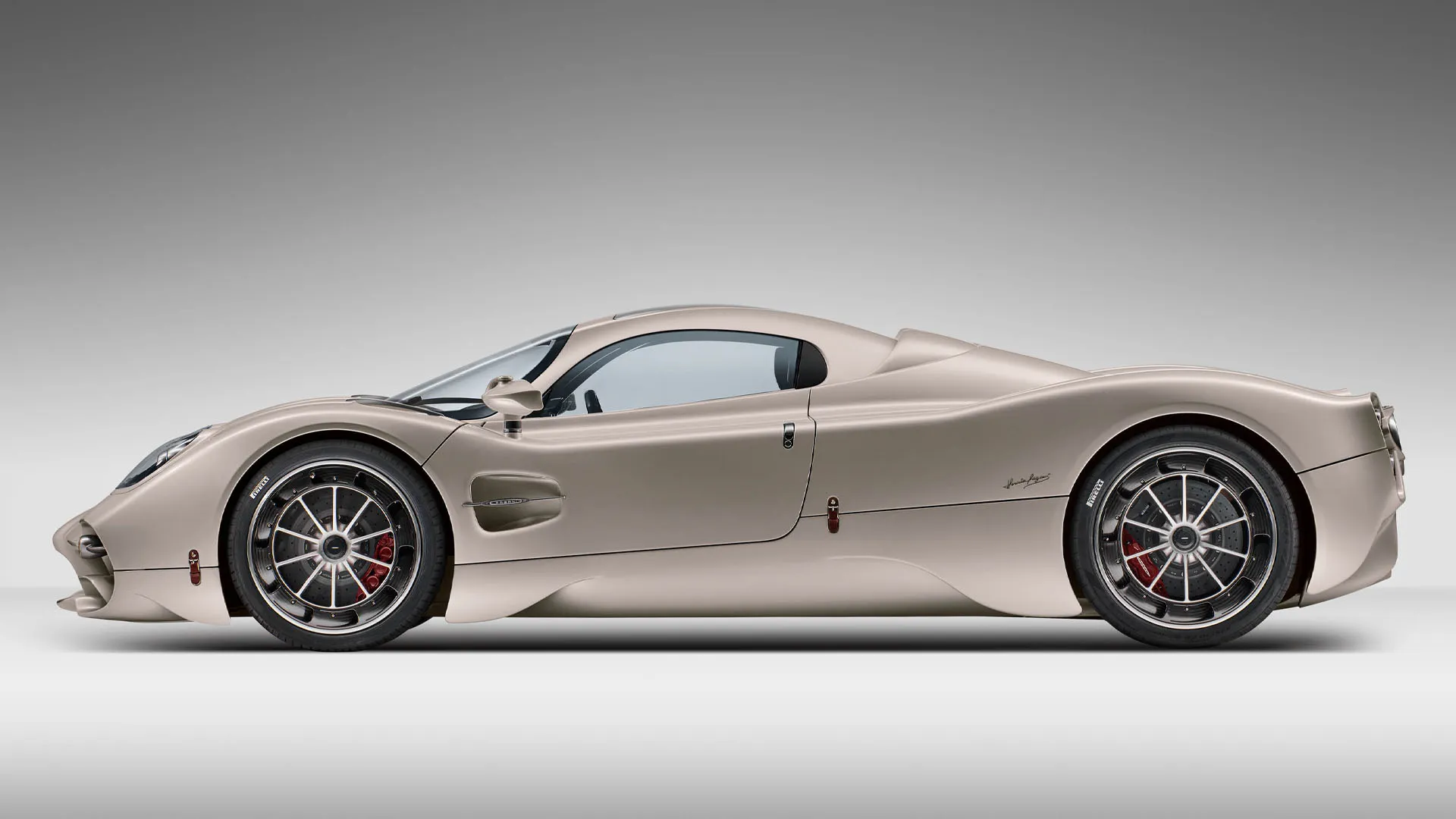
The Ferrari F80 is the apex of the “Big Five” Ferrari lineage, standing alongside the GTO, F40, F50, Enzo, and LaFerrari. In 2026, it represents the most extreme technological transfer from Formula 1 and the 24 Hours of Le Mans to a road-legal vehicle. While purists initially questioned the move from a V12 to a V6, the F80 has silenced all critics through sheer mathematical and mechanical dominance. It is the most powerful road car to ever leave the gates of Maranello, a machine that utilizes “Active Performance” to ensure that 1,200 horsepower is not just a number, but a usable tool for the driver. Every vent, every pixel, and every carbon fiber thread in the F80 serves a singular purpose: to make it the fastest lap-time vehicle in Ferrari history.
The heart of the F80 is a 3.0-liter 120-degree V6, but it shares almost nothing with a standard road engine. This engine is a direct descendant of the powerplant found in the Ferrari 499P, the car that won Le Mans in 2023 and 2024. On its own, the internal combustion engine produces 900 horsepower, a specific output of 300 hp per liter—the highest ever achieved by Ferrari. To reach these levels, Ferrari introduced e-Turbo technology for the first time on a road car. Between the turbine and the compressor of each turbocharger sits an electric motor. These motors can spin the turbos to maximum boost instantly, eliminating turbo lag entirely. More importantly, at high revs, they act as generators, harvesting excess energy from the exhaust gases to recharge the car’s 2.3 kWh high-voltage battery.
Supporting the V6 is a triple-motor hybrid system that adds another 300 horsepower, bringing the total output to 1,200 CV (1,184 HP). Two motors are located on the front axle, giving the F80 electronic all-wheel drive and sophisticated torque vectoring. The third motor is integrated into the 8-speed dual-clutch transmission at the rear. This setup allows the F80 to accelerate from 0 to 100 km/h in a staggering 2.15 seconds and reach 200 km/h in just 5.75 seconds. The top speed is electronically limited to 350 km/h, but it is the car’s mid-range acceleration—where the e-Turbos and electric motors work in perfect harmony—that truly separates it from every other Ferrari in existence.
Aerodynamics on the F80 are “extreme” in the literal sense of the word. The car is designed to generate 1,000 kg (2,204 lbs) of downforce at 250 km/h. This is achieved through a combination of an active rear wing that adjusts its height and pitch in milliseconds and a massive “S-Duct” at the front. The S-Duct pulls air from the front bumper and ejects it over the hood, creating a low-pressure zone that sucks the front tires to the road. The rear diffuser is equally radical, stretching from the middle of the car to the exhaust tips, effectively turning the entire underbody into a giant wing. This level of aerodynamic pressure allows the F80 to corner with G-forces that would be physically painful for an untrained driver.
To manage these extreme loads, Ferrari developed a new Active Suspension System in collaboration with Multimatic. Unlike traditional adaptive dampers, each of the F80’s shock absorbers is powered by its own 48-volt electric motor. This system is so fast that it can “pre-load” the suspension before the car even enters a corner, keeping the body perfectly level regardless of the downforce or cornering speed. It eliminates the need for anti-roll bars entirely, allowing the car to be soft and compliant over bumps while remaining rock-solid during a qualifying lap. This suspension is the “secret sauce” that makes the F80’s 1,200 horsepower accessible on a bumpy public road.
The Ferrari F80 is a masterclass in integration. It takes the complex energy-management systems of a Formula 1 car and the aerodynamic secrets of a Le Mans winner and packages them into a vehicle that can be driven to a local café. It is a car that doesn’t just represent the future of Ferrari; it defines the future of the hypercar itself. In the 2026 landscape, the F80 is the new benchmark, a 1,200-horsepower testament to the fact that when Ferrari decides to move the goalposts, they move them miles beyond anyone else’s reach.
The Ferrari F80 is more than a car; it is a packaging miracle. In traditional hypercars, the interior is often a place of compromise between driver and passenger comfort. For the F80, Ferrari’s designers, led by Flavio Manzoni, asked a radical question: “What if we designed a car as a single-seater that happens to have space for a friend?” This led to the creation of the “1+” seating configuration, a layout that defines the F80’s narrow, missile-like silhouette. By shifting the focus almost entirely to the driver, Ferrari was able to reduce the car’s frontal area, slashing aerodynamic drag and allowing the car to cut through the air with the efficiency of a jet fighter.
The 1+ Seating Revolution: Driver as Protagonist
The interior of the F80 is unlike any other road car in history. The driver’s seat is a bright red, ergonomically sculpted bucket that is positioned slightly ahead of the passenger. In contrast, the passenger seat is finished in black and is integrated directly into the padding of the carbon-fiber tub. From certain angles, the passenger seat almost “disappears” into the cabin’s trim. This longitudinal offset—placing the passenger slightly behind the driver—allowed Ferrari to make the cabin significantly narrower without sacrificing shoulder room. The result is a cockpit that feels like an enclosed Formula 1 car, where every screen, dial, and surface is oriented toward the person behind the wheel.
The steering wheel is also a new milestone for Maranello. Smaller than the wheel in the SF90, it features flattened top and bottom rims to improve visibility. Most significantly, Ferrari has brought back physical buttons on the steering wheel spokes. After a period of using haptic touchpads, the F80 returns to tactile switches that can be identified by touch alone, ensuring the driver never has to look down while navigating a corner at 150 mph. This focus on “haptic certainty” is a direct response to feedback from Ferrari’s most elite track drivers.
The Carbon Monocoque and 3D-Printed Anatomy
The chassis of the F80 is a “cocktail” of advanced materials designed to withstand the immense 1,000 kg of downforce the car generates. The central cell and the roof are made entirely from pre-preg carbon fiber, while the front and rear subframes are constructed from high-strength aluminum secured with titanium bolts. Compared to the LaFerrari, the F80’s chassis is 5% lighter but offers a staggering 50% increase in torsional stiffness.
Inside the wheel arches, you will find a world-first for a Ferrari road car: 3D-printed suspension wishbones. Using a process called additive manufacturing, Ferrari engineers created upper wishbones with an internal “lattice” structure that provides immense strength while weighing 5 kg less than traditional forged parts. This reduction in “unsprung mass” allows the active suspension to react even faster to road imperfections, keeping the tires in perfect contact with the asphalt.
Side Slip Control 9.0: The Real-Time Digital Twin
The “brain” of the F80 is the Side Slip Control (SSC) 9.0, which now incorporates a feature called FIVE (Ferrari Integrated Vehicle Estimator). This system essentially runs a “digital twin” of the car in real-time. Using a massive array of sensors, the car’s computer simulates exactly what the vehicle should be doing based on the driver’s inputs. It then compares this simulation to the actual physics occurring on the road.
If the car detects that the rear is beginning to slide more than the driver intended, the SSC 9.0 adjusts the torque vectoring on the front electric motors, the stiffness of the active suspension, and the angle of the active rear wing—all in a fraction of a second. This allows even a non-professional driver to explore the limits of a 1,200-hp machine with the confidence of a Le Mans winner. It is a car that doesn’t just protect you from your mistakes; it proactively helps you go faster.
Boost Optimization: Tailored Power for Every Track
A final innovative feature of the F80 is Boost Optimization. When the driver enters “Qualify” mode and selects a specific racetrack from the navigation system, the car “learns” the circuit during the first lap. It identifies the longest straights and the tightest corners. On the second lap, the car automatically manages its energy reserves, delivering maximum electrical boost exactly where it is most needed to achieve the fastest possible lap time. It is a level of automated energy management that was previously found only in the most elite levels of hybrid motorsport.