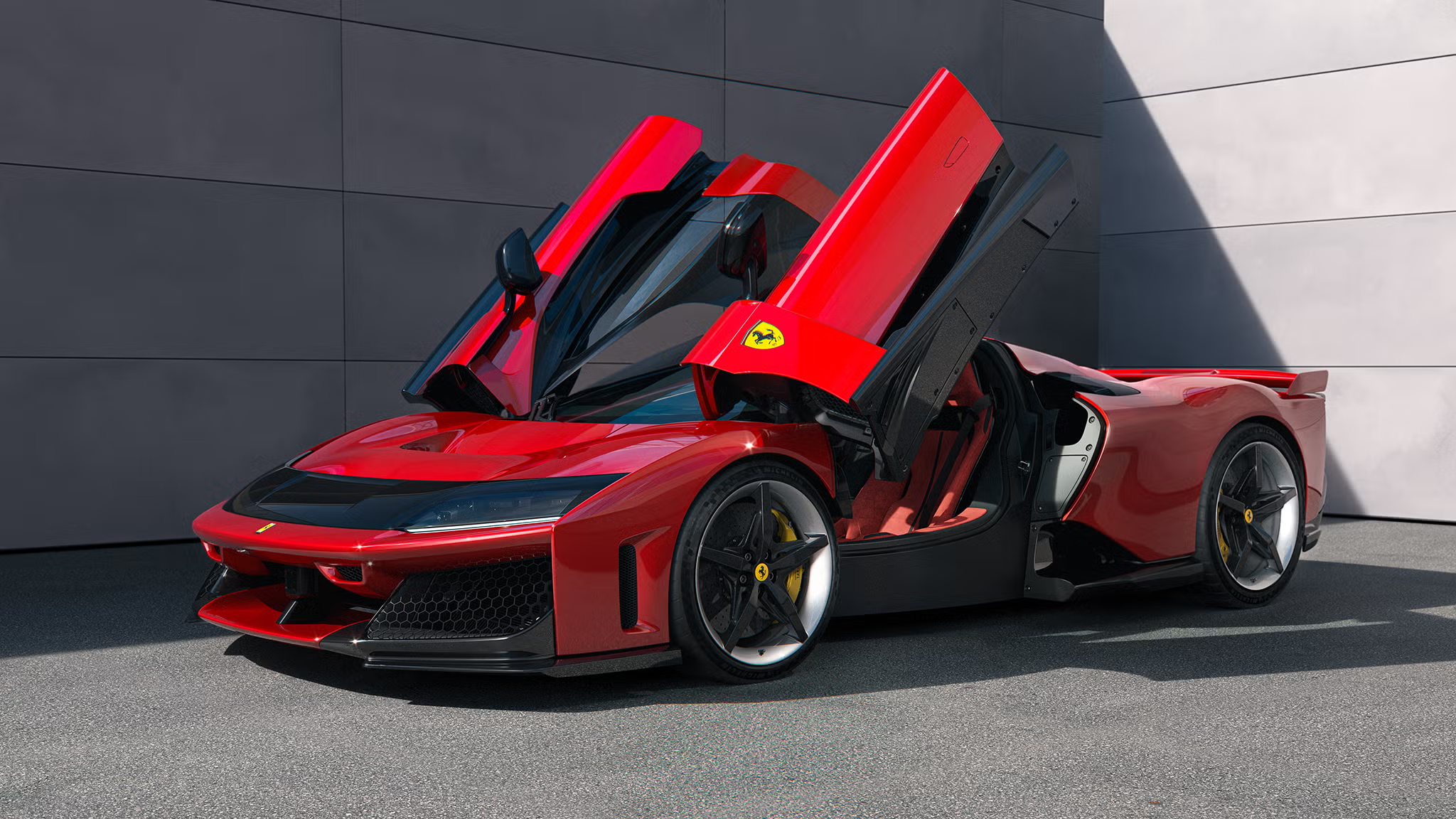

The Zenvo Aurora represents “The Second Chapter” for the Danish hypercar manufacturer, and it is a chapter written with fire and lightning. Named after the Aurora Borealis, this vehicle is Zenvo’s first ground-up, all-new design, moving away from the aging TSR platform. In 2026, the Aurora serves as a defiant statement in favor of the internal combustion engine, but with a futuristic hybrid twist. It is the first car to utilize a quad-turbocharged V12 designed in collaboration with MAHLE Powertrain, and it offers a level of raw, mechanical drama that few other manufacturers can match. By launching two distinct versions simultaneously—the track-focused Agil and the high-speed Tur—Zenvo has ensured that the Aurora can be either a scalpel for the circuit or a sledgehammer for the highway.
The heart of every Aurora is the Mjølner engine, named after Thor’s legendary hammer. This is a 6.6-liter, 90-degree V12 powerhouse that features four turbochargers. Unlike traditional quad-turbo setups that can be bulky, Zenvo utilized a “Hot-V” configuration, placing all four turbos inside the valley of the V12. This ensures the engine remains compact enough to fit into the car’s svelte carbon-fiber silhouette while providing immediate throttle response. On its own, the V12 produces a staggering 1,250 horsepower and revs to a screaming 9,800 RPM. It utilizes a “Jet Ignition” system where a pre-chamber ignites the fuel-air mixture before it enters the main cylinder, a technology derived directly from Formula 1 to ensure peak efficiency and power.
While the engine provides the thunder, the electrical system provides the lightning. The Aurora utilizes a modular hybrid system that changes depending on which version of the car you choose. The Aurora Agil (Danish for “Agile”) is the lightweight, rear-wheel-drive variant. It pairs the V12 with a single 200-hp electric motor integrated into the gearbox, resulting in a total output of 1,450 horsepower. This version is focused on pure driver connection and weighs less than 1,300 kg. Because it only has one motor, it provides a “torque fill” that bridges the gap while the four turbos are spooling up, giving the driver the sensation of a massive, naturally aspirated engine that never stops pulling.
For those who want the absolute maximum performance, there is the Aurora Tur (Danish for “Touring”). This version adds two additional 200-hp electric motors to the front wheels, creating an all-wheel-drive monster with a combined output of 1,850 horsepower and 1,700 Nm of torque. The Tur is the ultimate expression of the Aurora’s power, capable of sprinting from 0 to 100 km/h in just 2.3 seconds. While the Agil is limited to 365 km/h due to its high-downforce wings, the aerodynamically “slippery” Tur can accelerate all the way to a verified top speed of 450 km/h (280 mph). This makes the Zenvo Aurora Tur one of the fastest and most powerful road-legal vehicles ever conceived.
The chassis of the Aurora is a carbon-fiber work of art known as the ZM1 modular monocoque. This structure is incredibly stiff, with a torsional rigidity of 63,000 Nm per degree, yet it weighs only 120 kg. Zenvo made a deliberate design choice to leave 70% of this carbon-fiber monocoque exposed, treating the chassis like the skeletal architecture of a high-end superbike or a luxury timepiece. You can see the pushrod suspension arms and the carbon-fiber weaves from both the inside and the outside of the car. This transparency highlights the “Form Follows Function” philosophy that defines Danish design, where every component must be as beautiful as it is useful.
The suspension system is a pushrod-actuated double-wishbone setup at both the front and rear, featuring active springs that can adjust the car’s ride height and stiffness in real-time. To stop a car with nearly 1,900 horsepower, Zenvo equipped the Aurora with massive carbon-ceramic brakes and bespoke magnesium center-lock wheels. These wheels are wrapped in Michelin Pilot Sport Cup 2 tires, specifically chosen to handle the extreme thermal and mechanical loads of 450 km/h travel. The Zenvo Aurora is a car that doesn’t just push the boundaries of hypercar engineering; it shatters them. It is a 1,850-horsepower hammer from the north, ready to strike the global supercar hierarchy with the force of a god.
The Zenvo Aurora is a car that refuses to hide its secrets. While most hypercars wrap their engineering in layers of leather and carbon panels, Zenvo’s Head of Design, Christian Brandt, opted for a “Skeletal” philosophy. This phase of our 2,500-word deep dive explores the interior’s mechanical honesty, the “two-in-one” rotating dials, and the active aerodynamic “Air Brake” that makes the Agil a track predator. In 2026, the Aurora stands as a testament to Danish minimalism, proving that “less” is indeed “more” when the “less” involves 1,850 horsepower and a chassis that looks like a high-end timepiece.
The Skeletal Cockpit: Engineering as Art
Stepping into the Aurora—through its dramatic butterfly doors—is an experience in transparency. More than 70% of the ZM1 carbon-fiber monocoque is left completely exposed inside the cabin. You can see the weave of the carbon fiber, the aluminum hardpoints of the suspension, and even the electrical conduits. This isn’t a lack of finish; it is a deliberate artistic choice. The seats are not traditional heavy chairs but are instead lightweight pads affixed directly to the carbon-fiber monocoque. This saves weight and lowers the center of gravity, but it also creates a visceral “unfiltered” connection between the driver’s body and the road. To ensure comfort for all sizes, the seat padding is customized for each owner, and the steering wheel and pedal box are fully adjustable.
The Rotating Instrument Cluster: Analog Meets Digital
The centerpiece of the Aurora’s interior is its “Transforming” instrument cluster. To maintain a timeless, analog feel, the dashboard features three floating, circular dials that resemble high-end Swiss watches. The central dial is a permanent analog tachometer and speedometer, featuring a needle that sweeps across a 9,800 RPM range with mechanical precision.
However, the genius lies in the two flanking dials. When you need infotainment, navigation, or Apple CarPlay, these two dials physically rotate to reveal high-definition digital screens on their “back” sides. This allows the driver to have a pure, distraction-free analog experience during spirited driving, but still access modern GPS and telemetry when cruising. It is a brilliant solution to the “screen fatigue” found in modern cars, ensuring the Aurora’s interior will never look like an outdated piece of consumer electronics.
Aerodynamic Violence: The Agil’s Air Brake
The Aurora Agil (the track-focused version) is a study in managing air pressure. The most striking feature is the massive, rear-mounted “boomerang” wing. This wing is not static; it is an active aerodynamic tool that constantly adjusts its angle based on the car’s speed and lateral G-forces. During heavy deceleration, the wing flips into a near-vertical position, acting as a massive Air Brake. This shifts the aerodynamic balance rearward, allowing for more stable, flatter braking and preventing the nose from “diving.” In the Agil, the underbody is also active, with flaps that open to bleed off air pressure at top speed or close to create a vacuum that generates 880 kg of downforce at 250 km/h.
The Tur’s Silent Speed: Aerodynamic Efficiency
In contrast, the Aurora Tur (the touring-focused version) is about “the iron fist in a velvet glove.” It lacks the Agil’s giant wing, favoring a “longtail” rear design that allows air to detach cleanly, reducing drag. Instead of the aggressive vents seen on the Agil, the Tur uses “hidden” aerodynamic channels. Hot air from the radiators is directed through internal ducts and ejected into the wake of the car, effectively “filling” the low-pressure zone behind the vehicle and pushing it forward. This efficiency is what allows the 1,850-hp Tur to reach its staggering 450 km/h (280 mph) top speed while remaining stable and quiet enough for a cross-continental road trip.
Conclusion: A Danish Masterpiece
The Zenvo Aurora is the perfect conclusion to our list of 2026 supercars. It is a car that respects the past through its quad-turbo V12 and analog gauges, but embraces the future through its 3D-printed components and hybrid torque-fill. Whether you choose the track-focused Agil or the record-breaking Tur, the Aurora represents a “no-compromise” approach to hypercar design. It is a mechanical sculpture, a 1,850-horsepower thunderbolt from Denmark that proves that in the world of the ultra-elite, the most powerful statement is one made with clarity, transparency, and raw mechanical soul.